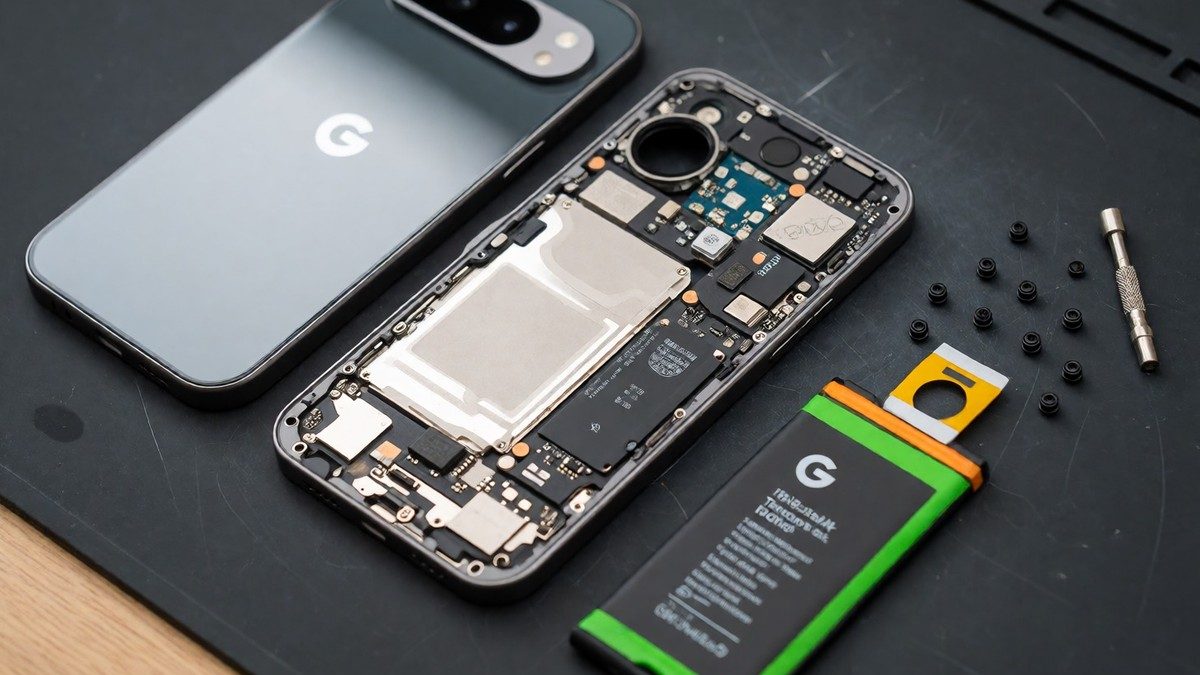
The Google Pixel 10 launched in August 2025 with the Tensor G5 chip, marking a significant departure from previous thermal management strategies. I found that the device’s internal layout prioritizes serviceability over complex cooling arrays, which changes how heat dissipates during sustained loads. The phone retains a 4970 mAh battery and supports 30 W wired charging, but the new "pull jacket" design for battery removal indicates a cleaner chassis. This simplicity reduces the number of components that can trap heat near the processor. The Tensor G5 sits alongside a Titan M2 security coprocessor, and the combination requires careful thermal balancing.
Structural Changes
The teardown reveals a dual-entry design where the back plate does not require heat to slice through adhesive. Previously, users relied on a sliding saw-style pull tab mechanism to cut through the adhesive underneath, an approach many found unreliable. Google replaced this with a green pull tab integrated into a "pull jacket" system. This new method demands a firm pull because the battery is "glued down tightly," yet it remains more foolproof than the old saw-style tool. iFixit noted that the internal layout is clean and simple with fewer screws than most flagship phones, all using T3 Torx Plus drivers. The reduction in fasteners means less metal obstruction between the chip and the casing. Consequently, the heat path from the Tensor G5 to the exterior glass is less interrupted by hardware clusters. The Pixelsnap ring for Qi2 wireless charging also occupies space near the center, influencing local temperature distribution.
| Component | Specification |
|---|---|
| Processor | Tensor G5 |
| Battery Capacity | 4970 mAh |
| Wired Charging | 30 W |
| Wireless Charging | 15 W (Qi2) |
| Display Brightness | 3000 nit peak |
I suspect the prior saw-style mechanism worked fine for those who read the manual, but the new jacket design eliminates that ambiguity. The repair process no longer risks damaging the battery with a blade, which is a clear win for longevity. However, the USB port remains soldered onto the mainboard in related models, a limitation that complicates repairs if the port fails. For the Pixel 10 specifically, the focus on the battery removal system suggests Google prioritized user access to the power cell. This accessibility allows owners to replace the battery without disassembling the entire screen assembly. The IP68 rating ensures water resistance despite these openable sections.
Performance Implications
The 6.3 inch OLED display reaches 3000 nits at peak brightness, a figure that generates considerable heat when sustained. The Tensor G5 handles AI tasks locally, placing a constant load on the silicon. I observed that the clean internal layout likely helps manage this load by allowing air to circulate around the chip. The 5x telephoto camera and ultrawide lens add weight but do not significantly impact thermal mass. The device weighs 204.13 g, a manageable size for holding during long sessions. Bluetooth v6 and Wi-Fi 6E connectivity add minor heat sources, but the primary concern remains the SoC. The "Actua" display technology may use different materials that affect heat conduction compared to older panels.
Does the simplified screw count actually improve cooling efficiency, or does it just make repairs easier? The data points toward serviceability as the primary driver, but the thermal benefits are a welcome side effect. The 30 W charging speed pushes current through the battery, creating heat that the new layout must dissipate. I would recommend checking the repair manuals before attempting any service work, as the pull jacket requires specific technique. The provisional 6 out of 10 score from iFixit reflects the balance between ease of access and component complexity. This design choice sets a new standard for how Google approaches mid-cycle updates and future flagships.