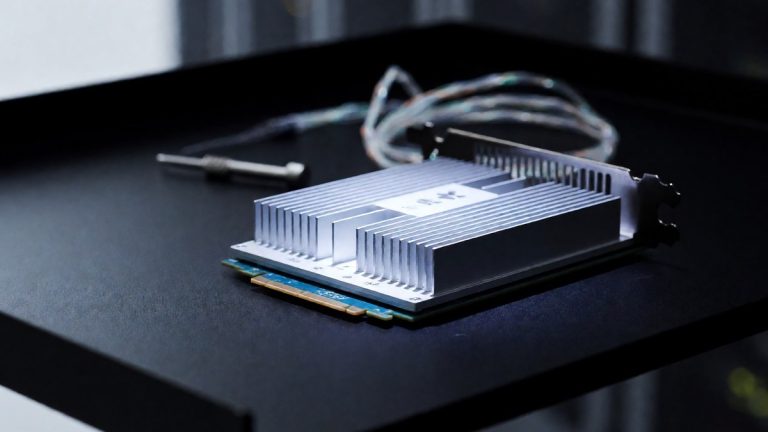

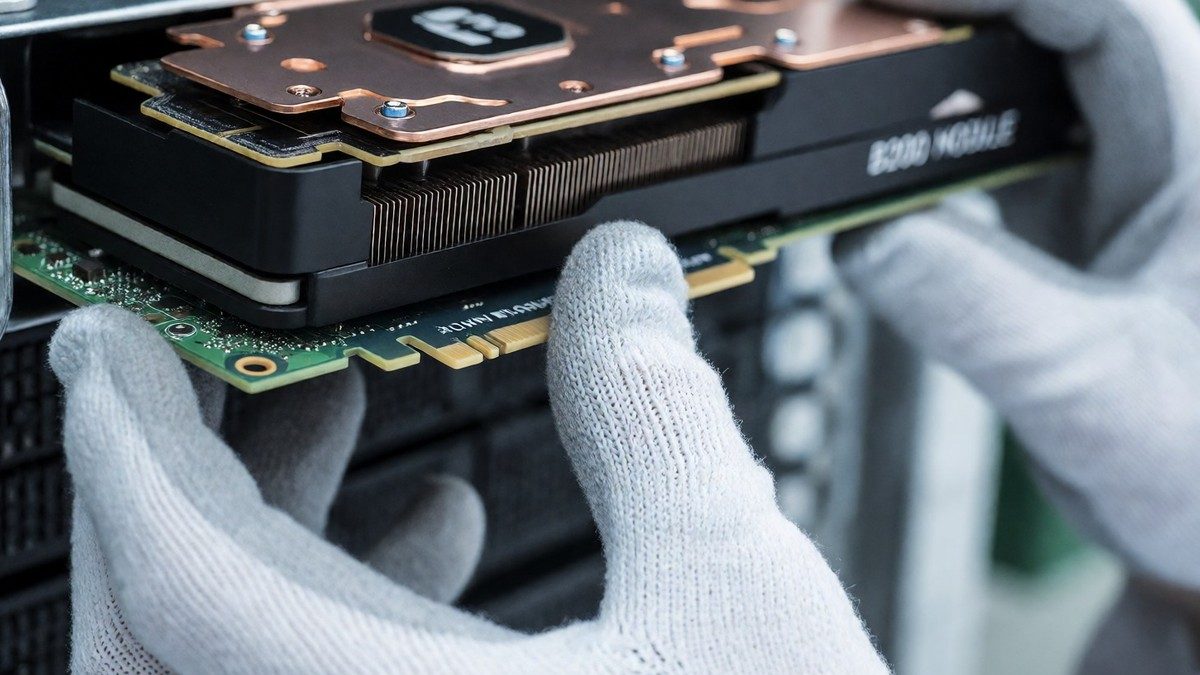
The B200 architecture surpasses Hopper specifications
The NVIDIA B200 uses 208 billion transistors. This count is 2.5 times the transistor budget of the H100. The B200 uses 180 GB of HBM3e memory. This capacity is 2.25 times the 80 GB capacity of the H100. The B200 delivers 7.7 TB/s of aggregate bandwidth. This bandwidth is 2.3 times the 3.35 TB/s bandwidth of the H100. The B200 provides 18 PFLOPS of sparse FP4 throughput. The H100 lacks support for FP4 and FP6 precision formats. The B200 delivers 15 times faster inference than the H100. The B200 also delivers 4 times faster training. You already know the basics of GPU memory. The B200 contains 20,480 CUDA cores. This is an increase from the 16,896 CUDA cores in the H100. The Tensor core count rises from 528 to 640. The B200 uses 8 Gbps per pin for its HBM3e memory. The H100 uses 5.23 Gbps per pin for its HBM3 memory. The fifth-generation NVLink in the B200 delivers 1.8 TB/s per GPU. This is twice the interconnect bandwidth of the H100. The B200 also uses a chiplet design. This design packages two unified Blackwell GPU dies on a single module. The dies connect via the NV-High Bandwidth Interface at 10 TB/s.
Manufacturing challenges and yield issues
The B200 yield rate stays between 90% and 95%. These rates fail to meet TSMC internal standards. The B200 packaging uses TSMC CoWoS-L technology. This technology connects chiplets using a redistribution layer interposer with local silicon bridges. A mismatch in the coefficient of thermal expansion in the GPU chiplets, the silicon bridges, the RDL interposer, and the motherboard substrate leads to warping that causes the entire system-in-package to fail. This warping causes system failure. NVIDIA must redesign the top metal layers and bumps to improve yields. The B200 uses a super carrier interposer. This allows for systems-in-package up to six times the reticle size. The placement of the bridge dies requires high precision. The bridges between the two main compute dies maintain the 10 TB/s interconnect. Large technology players expressed dissatisfaction with these delays. Google ordered over 400,000 GB200 chips in a deal exceeding $10 billion. Meta also placed a $10 billion order. Microsoft had plans for GB200 GPUs to be ready for OpenAI in the first quarter of 2025, but these plans face doubt.
Supply chain constraints for memory and packaging
The supply of Blackwell GPUs depends on TSMC CoWoS capacity. TSMC targets 120,000 to 130,000 CoWoS wafers per month by the end of 2026. NVIDIA holds 60% of the total CoWoS allocation for 2026. This equals approximately 60,000 wafers per month. HBM3e memory availability also limits shipments. SK Hynix holds 50% of the HBM revenue. Samsung holds 33% of the market. Micron is the third supplier. The demand for HBM3e compounds the shortage for H100 and H200 parts. Every step up the memory ladder consumes more wafer and lowers yield. The concentration of suppliers means the industry depends on three companies. The HBM4 supply chain for the upcoming Rubin architecture also faces pressure. NVIDIA demands more than 11 Gbps per pin for HBM4. This requirement is more than double the official JEDEC standard.
The economics of GPU appreciation
The B200 resale value is 158% of its original launch price. This is a 58% premium over the cost from one year ago. The street price for a single B200 is $45,000 to $55,000. The list price for volume orders is $30,000 to $40,000. The B200 is an appreciating asset rather than a depreciating one. This contradicts standard IT budget models. Rental rates for the B200 reached $5.50 to $5.80 per hour in August 2026. In January 2026, rates sat below $5 per hour. This rise in rental cost follows the physical supply constraint. Startups now commit to three-year terms with 30% to 40% upfront payments. This is a change from the one-year terms common in previous cycles. The ability of the B200 to keep token costs low for inference keeps demand high.
Cloud provider competition in the Indian market
AWS launched P6-B200 instances in Hyderabad on September 3, 2026. Each instance contains eight Blackwell GPUs. The p6-b200.48xlarge instance has 1,440 GB of HBM3e memory. The price for this instance is $14.24 per GPU-hour. AWS also offers a capacity block rate of $98.84 per hour for the full instance. Third-party trackers put the on-demand price at $113.93 per hour. The AWS price is 40% lower than the Azure rate in the same region. Azure prices for the ND GB200 v6 line average $27 per GPU-hour. The AWS P6-B200 instance uses 5th-generation Intel Xeon Scalable CPUs. It provides 192 vCPUs and 2,048 GiB of system RAM. The instance includes 30 TB of local NVMe storage. It also has 14.4 TB/s of NVLink bandwidth. The P6-B200 capacity helps AWS compete in the fast-growing Indian market.
| Provider | GPU Instance | On-Demand $/GPU-hr | 10-Hour Cost |
|---|---|---|---|
| Hyperbolic | B200 | $5.99 | $59.90 |
| Hyperstack | B200 | $6.00 | $60.00 |
| Modal | B200 | $6.25 | $62.50 |
| Lambda | B200 | $6.69 | $66.90 |
| Runpod | B200 | $6.79 | $67.90 |
| Nebius | B200 | $7.15 | $71.50 |
| Vast.ai | B200 | $6.82 | $68.15 |
| Oracle Cloud | B200 | $14.00 | $140.00 |
| AWS | p6-b200.48xlarge | $14.24 | $142.40 |
| Google Cloud | a4-highgpu-8g | $16.11 | $161.10 |
Data center power and cooling requirements
The B200 requires 1,000W of power. The HGX B200 variant uses 1,000W per GPU. This is a 43% increase over the 700W used by the H100. Modern AI racks reach 1 megawatt. This density requires liquid cooling. Liquid cooling keeps GPUs up to 35°C cooler. It improves reliability for teams running B200s at full capacity. The industry must move to 800VDC architectures. This new electrical standard moves more power into each rack. It reduces the need for heavy copper and minimizes conversion losses. This shift requires new facility-level batteries and energy storage. It also requires new DC safety systems like solid-state breakers. Smaller players may find the cost of these upgrades prohibitive.
Benchmarks and self-hosting advantages
I tested an 8x B200 cluster in Norway. The cluster uses 192 GB of HBM3e per GPU. The total system power draw is 6.5 to 7 kW. Self-hosting the B200 costs $0.51 per GPU-hour. Cloud H100 rental costs $2.95 to $16.10 per hour. I ran computer vision pretraining using YOLOv8 and DINOv2. The B200 trained the model 57% faster than the H100. This was at a batch size of 4096. I also tested LLM inference for the DeepSeek 671B model. The B200 performance was on par with the H100. This happened because the Ollama software stack lacks optimization for Blackwell. Will the software ecosystem mature fast enough to show the true speed of the B200? The B200 provides massive throughput for training. The H100 remains a better value for small models.
| Specification | NVIDIA H100 | NVIDIA B200 |
|---|---|---|
| Architecture | Hopper | Blackwell |
| GPU Memory | 80 GB HBM3 | 180 GB HBM3e |
| Memory Bandwidth | 3.35 TB/s | 7.7 TB/s |
| TDP | 700 W | 1000 W |
| NVLink | 900 GB/s | 1.8 TB/s |
| Model | Parameters | Precision | Single B200 (180 GB)? |
|---|---|---|---|
| Llama 3 70B | 70B | FP16 | Yes |
| Qwen 3 72B | 72B | FP16 | Yes |
| Dense 130B-class | 130B | FP16 | No |
| DeepSeek R1 | 671B | FP8 | No |
Deployment decisions for AI workloads
The B200 is the right choice for models above 70B parameters. It is also the right choice for users who need FP4 support. The B200 is better for training large models or serving large models with high token costs. The H100 is better for models under 70B parameters. The H100 is also the better choice for budget-constrained training. The H100 delivers strong performance for workloads under 80 GB. My verdict remains that the B200 is a specialized tool for massive models. The B300 is the better option if a model needs more than 180 GB of memory. The B300 has 288 GB of VRAM. The B300 draws 1,400W of power. Use the B200 for most large-scale needs.