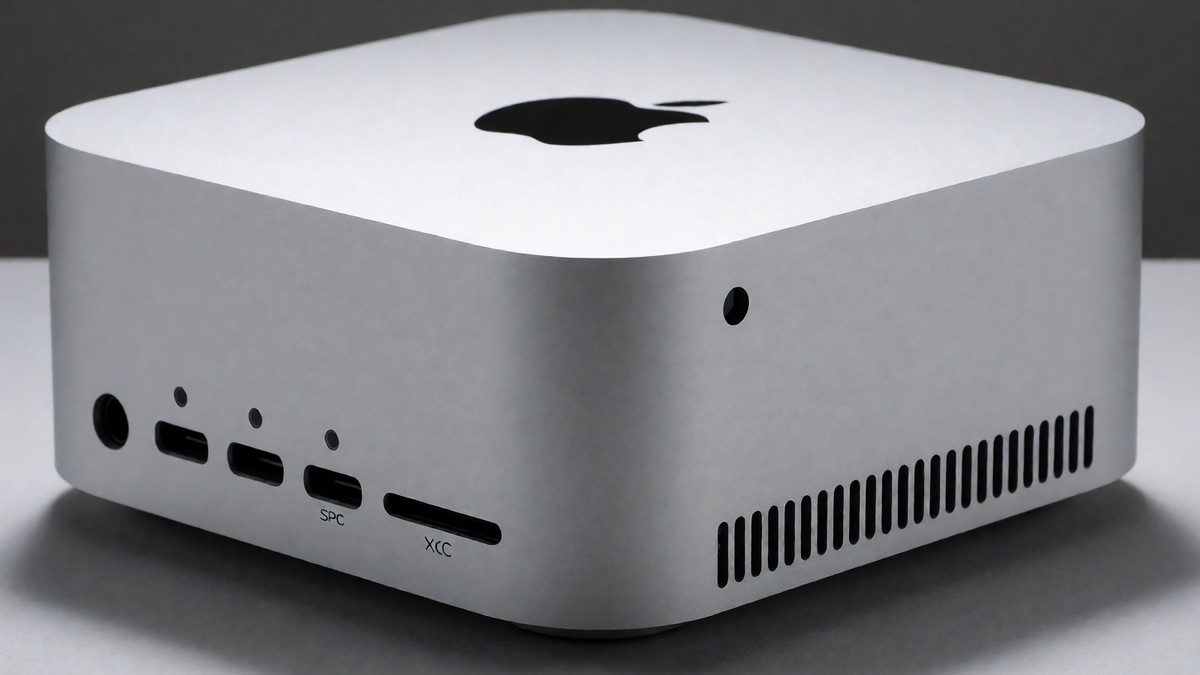
Unmatched local AI processing
The M5 Ultra Mac Studio delivers 4.3x faster AI compute performance than the M3 Ultra. This workstation handles large language models with over 600 billion parameters entirely in memory because it utilizes up to 512GB of unified memory for its intensive AI processing needs. In LM Studio, the M5 Ultra produces 4x faster LLM prompt processing than the M4 Max, which helps professional developers running complex simulations without needing external cloud resources for their work. Professionals working with complex VFX simulations or massive engineering datasets clearly benefit from these specific upgrades. The M3 Ultra uses a "32-core Neural Engine", but the M5 Ultra scales this much higher for intensive tasks. The M5 Ultra provides 16.9x faster LLM token generation than the M1 Ultra and 2.6x faster scene rendering in Maxon Redshift compared to the M1 Ultra. You should prioritize the M5 Ultra if your current projects require more than 128GB of memory or significant GPU power. The M5 Ultra can also play 33 streams of 8K ProRes 422 video at 30fps. The M5 Max provides 4.3x faster AI performance compared to the previous generation. However, the M5 Ultra costs $3,000 more than the M5 Max, which remains a steep jump for many users.
Manufacturing shifts and chip rivalry
TSMC is currently expanding its 2nm capacity to meet growing demand. The company reported that its 2nm wafer revenue reached 8% of total revenue in Q3 2026, increasing from 3% in the second quarter. Samsung reports a 40% yield rate for its 2nm process, but TSMC already achieves 80% yield rates for its own 2nm production. Apple and NVIDIA both eye these 2nm advancements to maintain their hardware edges. Qualcomm fights to stay relevant against Apple’s silicon in the enterprise market. The Snapdragon X Elite provides 12 Oryon cores and a multi-core Geekbench 6 score of 14298. The Apple M4 outperforms the Snapdragon X Elite in single-core tasks with a score of 3864, representing a 58% lead. The M4 also achieves a 3% advantage in multi-core performance over the Snapdragon. The M4 reaches a Metal GPU score of 57603, while the Snapdragon X Elite hits 23649 on Vulkan. Will Qualcomm’s next-generation solution close this gap?
Professional specifications and value
The M5 Ultra remains the best choice for users needing more than 128GB of unified memory or eight external displays. The M5 Max starts at $2,499 and includes an 18-core CPU and 32-core GPU. This configuration provides 500GB/s of unified memory bandwidth. The M5 Max delivers 1.6x faster image processing in Adobe Photoshop and 2.1x faster build performance in Xcode compared to the M1 Max. It also provides 5x faster video processing in Topaz Video AI than the Intel-based 27-inch iMac. The M5 Ultra starts at $5,499 and provides a 30-core CPU and 64-core GPU. It reaches 1.2TB/s of unified memory bandwidth. The M5 Ultra provides 1.7x faster Redshift rendering than the M3 Ultra. Both models use Thunderbolt 5 with speeds up to 120Gb/s.
| Specification | M5 Max | M5 Ultra |
|---|---|---|
| CPU Cores | 18-core | 30-core |
| GPU Cores | 32-core | 64-core |
| Unified Memory | 36GB to 128GB | 96GB to 512GB |
| Max Storage | 8TB | 16TB |
| Thunderbolt Ports | 4 | 6 |
The M5 Max configuration includes two USB-C ports with 10Gb/s and an SDXC card slot. The M5 Ultra upgrades the front connections to two full Thunderbolt 5 ports. This brings the total to six Thunderbolt 5 ports for the Ultra model. The M5 Max suffices for most editing, coding, and audio workstations. The M5 Ultra makes sense for large local language models that cannot fit within 128GB or for professional multicamera workflows.