
Apple Watch Series 10 breathing disturbance tracking
The Apple Watch Series 10 uses an accelerometer to monitor wrist movements for breathing disturbances. This sensor detects small movements associated with interruptions in normal respiratory patterns during sleep. This feature identifies signs of moderate to severe obstructive sleep apnea (OSA) in users aged 18 or older. Users find their nightly data in the Health app on an iPhone, where the system classifies breathing disturbances as either elevated or not elevated. The Apple Watch Series 10 provides a method to identify breathing disturbances by using a built-in accelerometer to detect small wrist movements that indicate interruptions in normal respiratory patterns during sleep.
The breathing disturbance metric helps users detect consistent signs of OSA. Users see these metrics in the Health app, which shows data over one-month, six-month, or one-year periods. If the watch detects repeated abnormal breathing patterns over time, it sends a notification suggesting the user speak with a doctor. The Apple Watch Series 10 supports an 18-hour battery life, which requires users to charge the device during the day. This feature works on the Apple Watch Series 9, Apple Watch Series 10, and Apple Watch Ultra 2.
The notification algorithm and clinical validation
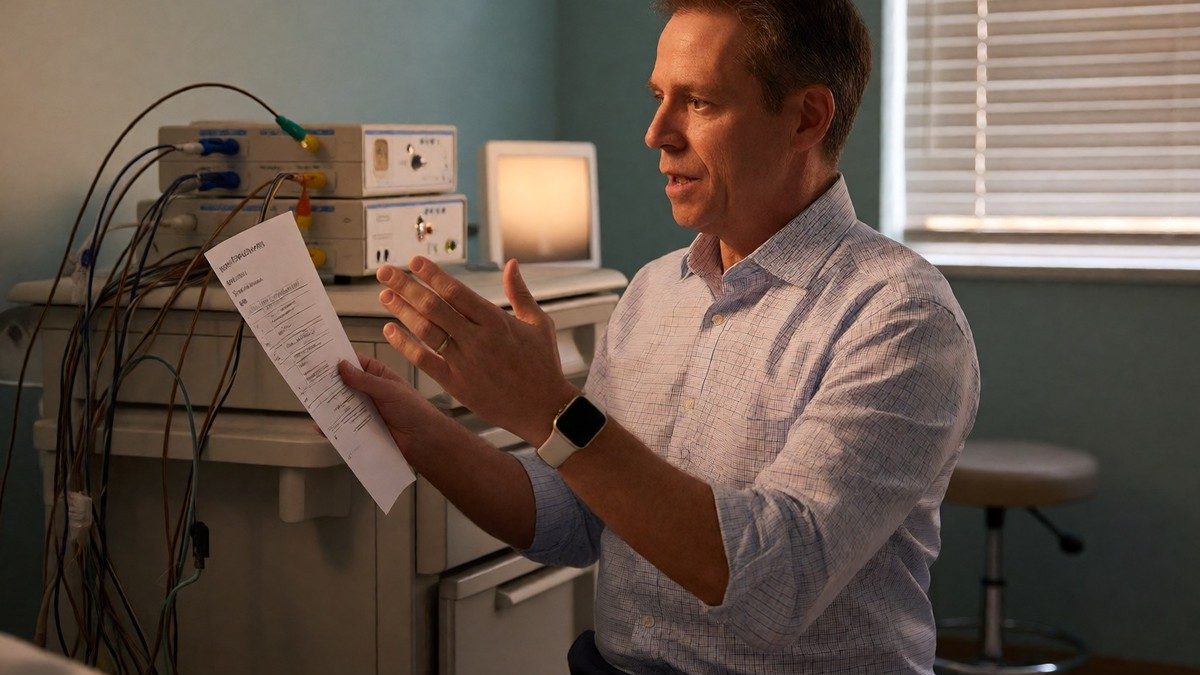
The notification algorithm uses machine learning and an extensive data set of clinical-grade OSA tests. Apple validated the feature in a clinical study involving 1,448 subjects. Every participant identified by the algorithm had at least mild sleep apnea. The watch analyzes breathing disturbance data every 30 days and notifies users if the data shows consistent signs of moderate to severe OSA. This notification includes educational materials and a PDF containing three months of historical data for use in conversations with a healthcare professional.
The algorithm targets moderate to severe cases of OSA. It does not aim to detect mild sleep apnea. The Apple Watch received FDA 510(k) clearance for this notification feature on September 13, 2024. The feature relies on the accelerometer to identify the breathing disturbances. The Apple Watch Series 10 does not provide a medical diagnosis.
Comparing accuracy between Apple and Samsung
Samsung provides sleep apnea notifications through its Galaxy Watch 7, 8, and Ultra models. Samsung received FDA De Novo authorization for this feature in February 2024. The Samsung device uses a proprietary BioActive sensor to collect data via PPG. A published clinical validation study of 620 adults showed the Samsung device has 82.7% sensitivity and 87.7% specificity for detecting moderate-to-severe OSA. The Samsung Health Monitor app processes results after the user completes at least two nights of four or more hours of tracked sleep within a 10-day period.
| Device | FDA Clearance for OSA | Primary Sensor | Starting Price |
|---|---|---|---|
| Apple Watch Series 9/10/Ultra 2 | Yes | Accelerometer | $399 |
| Samsung Galaxy Watch 7/8/Ultra | Yes | BioActive (PPG) | Not stated |
| Withings Sleep Analyzer | Yes | Ballistography | $150 |
| Oura Ring 4 | No | PPG | $349 |
| Fitbit Charge 6 / Sense 2 | No | PPG/Motion | $99 |
| Garmin Venu 3 / Vivosmart 5 | No | Pulse Ox/Motion | Not stated |
The Apple Watch sleep staging algorithm uses a 3-axis accelerometer. Apple’s updated 2025 algorithm achieved a four-stage kappa of 0.68 in a validation study. This value falls into the substantial category on the Landis and Koch scale. In a separate cohort of clinical patients, the updated algorithm achieved a kappa of 0.66, with 95.0% sensitivity and 86.5% specificity.
Limitations of consumer wearables
Consumer wearables cannot diagnose sleep disorders. They identify patterns that merit clinical evaluation. These findings serve as screening indicators rather than diagnostic results. A notification from a smartwatch does not replace a formal medical diagnosis. Users should follow up with a healthcare provider to get an official diagnosis.
The Apple Watch sleep staging algorithm relies on motion patterns. It does not use electroencephalography (EEG) to measure brain activity. This differs from polysomnography (PSG), which uses EEG, electro-oculography (EOG), and electromyography (EMG). An independent 2024 study found the Apple Watch Series 8 had a 43-minute mean underestimate of deep sleep. The Apple Watch remains optimized for moderate-to-severe OSA, so it may miss mild cases.
You already know that a consumer device provides a wellness signal rather than a medical confirmation. Dr. David Kuhlmann notes that insurance companies will not pay for sleep apnea therapies like CPAP machines based on Apple Watch data alone. Users must obtain a diagnosis from a professional to receive treatment.
Alternatives to the Apple Watch
Several devices provide home-based sleep monitoring. PranaQ’s TipTraQ received FDA clearance in February 2025. This device uses PPG sensors and accelerometers to capture pulse rate, SpO2, respiration, and motion. It categorizes apnea severity into mild (5+), moderate (15+), or severe (30+). The device uses trials from Duke and UCSF to validate its results against polysomnography standards.
The Withings Sleep Analyzer provides FDA-cleared apnea screening. It uses an under-mattress ballistography pad that requires no skin contact. The device costs $150. Wis Medical offers the Tedream patch system, which uses sensors on the forehead, chest, and forearm. This system monitors brain activity, heart rhythm, blood oxygen levels, snoring, and body position.
The Oura Ring 4 tracks overnight SpO2, respiratory rate, and heart rate variability. It does not generate an apnea-specific alert. The ring costs $349 or more and requires a $6 monthly membership. The SleepHQ O2 Sleep Tracking Ring Pro focuses on overnight oxygen saturation. This ring costs between $349 and $499.
| Device | Type | Primary Function |
|---|---|---|
| PranaQ TipTraQ | Wearable | Apnea severity categorization |
| Withings Sleep Analyzer | Under-mattress | Breathing and heart rate monitoring |
| Tedream Patch | Wearable Patch | Brain activity and oxygen monitoring |
| Oura Ring 4 | Smart Ring | Wellness and recovery metrics |
| SleepHQ O2 Ring Pro | Smart Ring | Continuous overnight SpO2 |
The economic impact of home testing
The sleep apnea diagnostic devices market reached 6.99 billion USD in 2026. This market is projected to reach 10.2 billion USD by 2032. Home sleep apnea testing provides a cheaper alternative to clinical visits. Traditional in-lab polysomnography costs an average of $3,000. At-home sleep apnea tests from providers like Sleep Doctor cost $189. The Apple Watch Series 10 starts at $399.
The expansion of home testing helps reduce the workload for healthcare professionals. Companies like EnsoData received FDA clearance for the EnsoSleep algorithm in February 2024. This technology uses AI to review sleep data and assist clinicians. The market for wearable sleep apnea breathing-monitoring devices grows at an 8.5% CAGR. This growth stems from the demand for non-invasive solutions.
The regulatory landscape for sleep technology
The FDA regulates devices that attempt to diagnose medical conditions. Basic sleep tracking using optical sensors and movement detection falls under general wellness technology. This category is not heavily regulated. Once a device claims to detect sleep apnea, it becomes a regulated medical device.
New FDA guidance taking effect in January 2026 provides flexibility for low-risk wellness products. This includes wearables that estimate heart rate or blood oxygen levels for general insights. However, these devices cannot present readings as clinical measurements without strong evidence. Regulatory agencies such as the FDA and European authorities update rules to manage these innovations.
In the US, the home sleep apnea testing market grew from 2.90 billion USD in 2025 to 3.11 billion USD in 2026. This growth shows a shift toward home-based care. The broader sleep studies market, valued at 7.06 billion USD in 2026, is expected to reach 14.93 billion USD by 2033.
Determining if the Apple Watch fits a user’s needs
The Apple Watch Series 10 provides a useful tool for people who suspect they have sleep apnea. It works well for users who experience loud snoring, excessive daytime fatigue, or restless sleep. Tech-savvy users who already own an Apple Watch can integrate this feature into their existing health ecosystem. The device is helpful for people with risk factors like obesity, age, or a family history of sleep apnea.
The Apple Watch Series 10 provides the most user-friendly experience for tracking breathing disturbances. It combines easy overnight wear with a validated notification system. Users receive a notification if the data shows consistent signs of moderate to severe OSA. The notification includes a PDF with three months of data to share with a doctor. The Apple Watch Series 10 is the best option for users who want a low-friction way to monitor sleep patterns. Will the ability to monitor sleep from home eventually replace the need for hospital-based polysomnography?