Anduril Industries’ shipyard plan challenges established shipbuilders
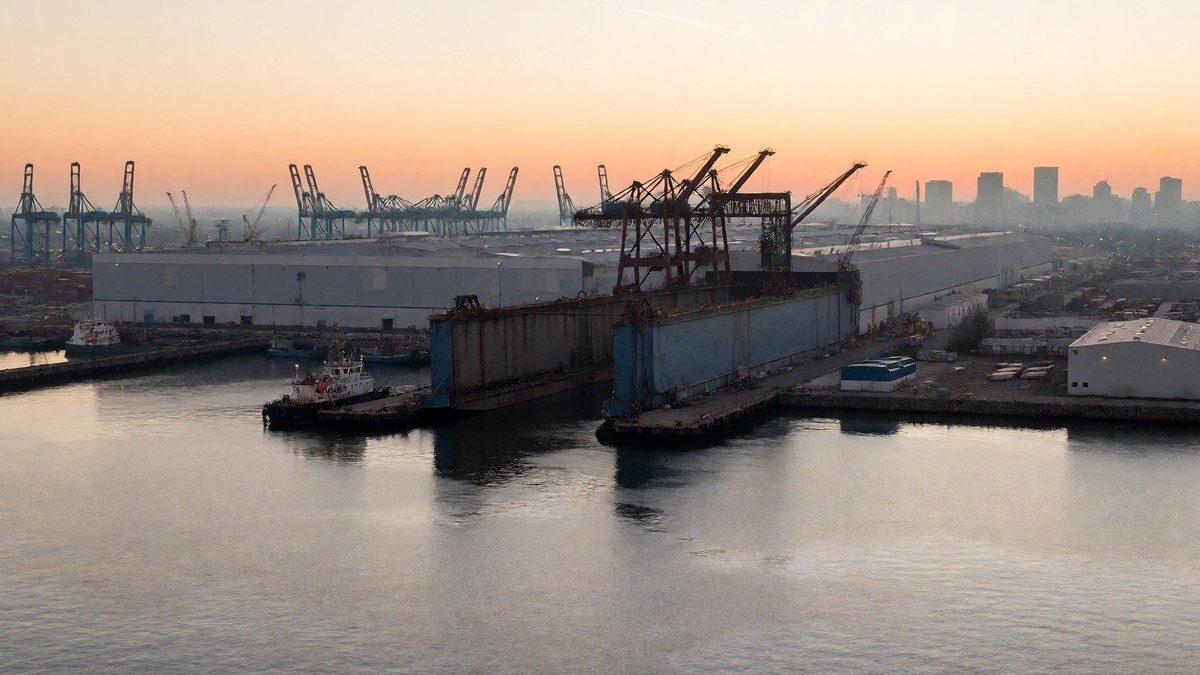
Anduril Industries’ $6.6 billion shipyard plan challenges the dominance of General Dynamics Electric Boat and Newport News Shipbuilding. The company invests $3.7 billion in the Arsenal-2 facility at Tradepoint Atlantic to manufacture Virginia-class components. This project, which combines $3.7 billion in private investment with a $2.9 billion Navy contract, seeks to produce complex submarine components to alleviate the current production bottlenecks facing Virginia-class submarine manufacturers. The facility, which covers 2 million square feet and includes a 1,200-foot graving dock, addresses the fact that current production lines cannot meet US Navy requirements or AUKUS commitments while satisfying the demand for more subsea hulls. Anduril also builds a 160,000-square-foot facility in Orange County, California, for torpedo tube production and test assets. This dual-facility approach creates 3,100 direct jobs and $2 billion in annual economic output. Such investments arrive as the global unmanned underwater vehicles market heads toward a $46.62 billion valuation by 2035.
AUKUS shifts toward uncrewed underwater payloads
The AUKUS alliance revised its submarine acquisition plan during the May 30, 2026, Shangri-la Dialogue. Australia will receive three in-service Virginia-class nuclear-powered attack submarines instead of the previous combination of new and used units. This change aims to simplify the supply chain and maximize cost-effectiveness amidst production bottlenecks. The trilateral partners also launched the first Pillar II project for unmanned underwater vehicle (UUV) payloads. These vehicles arrive in 2027 to provide reconnaissance, strike, anti-submarine warfare, mine countermeasures, and electronic warfare capabilities. The UK provides £150 million for this endeavor. This effort follows the US Navy’s FY2025 budget request of $191.5 million for its UUV Family of Systems. The US Navy also plans for 5 additional prototype units of Boeing’s 26-meter long Orca XLUUV, which has an 8-ton payload capacity and a 6,500 nautical mile range. Within the broader market, the defense sector accounts for 39.15% of the unmanned underwater vehicles industry. Japan already placed a 2025 order for more than 12 Remus 300 units to bolster its capabilities. Can the trilateral alliance maintain this pace while China continues to sanction American defense firms like Anduril and L3Harris?
Barracuda modularity and production speed
Anduril’s Barracuda cruise missiles cost 30% less than comparable systems. The modular design allows operators to swap subsystems like Lego blocks. The Barracuda-500 version loiters for more than two hours and carries over 100 pounds of payload. You should note how the company builds these via a hyperscale production strategy using fewer parts and only 10 assembly tools. This method scales production according to demand. The Barracuda-100 variant carries 35 pounds and reaches a range of 85 miles when launched from the air, while the Barracuda-250 version reaches a range of 200 nautical miles with its own unique subsystem configurations. All versions fly up to 500 knots and withstand 5 G-forces.
| Feature | Barracuda-100 | Barracuda-250 | Barracuda-500 |
|---|---|---|---|
| Range | 85 miles | 200 nautical miles | 500+ nautical miles |
| Payload | 35 pounds | 35 pounds | 100+ pounds |
| Speed | 500 knots | 500 knots | 500 knots |
| Capability | Direct/Stand-off | Direct/Stand-off | Loiter 2+ hours |
Anduril also produces AUVs via its Dive-LD division, with a Rhode Island factory targeting 200 units per year. These customized 3-D printed hulls suit undersea battlespace intelligence, mine counter-warfare, and seafloor mapping. I find the 110-hour battery life of the Remus 620 from HII a stronger benchmark for endurance, though Anduril’s volume targets remain aggressive.