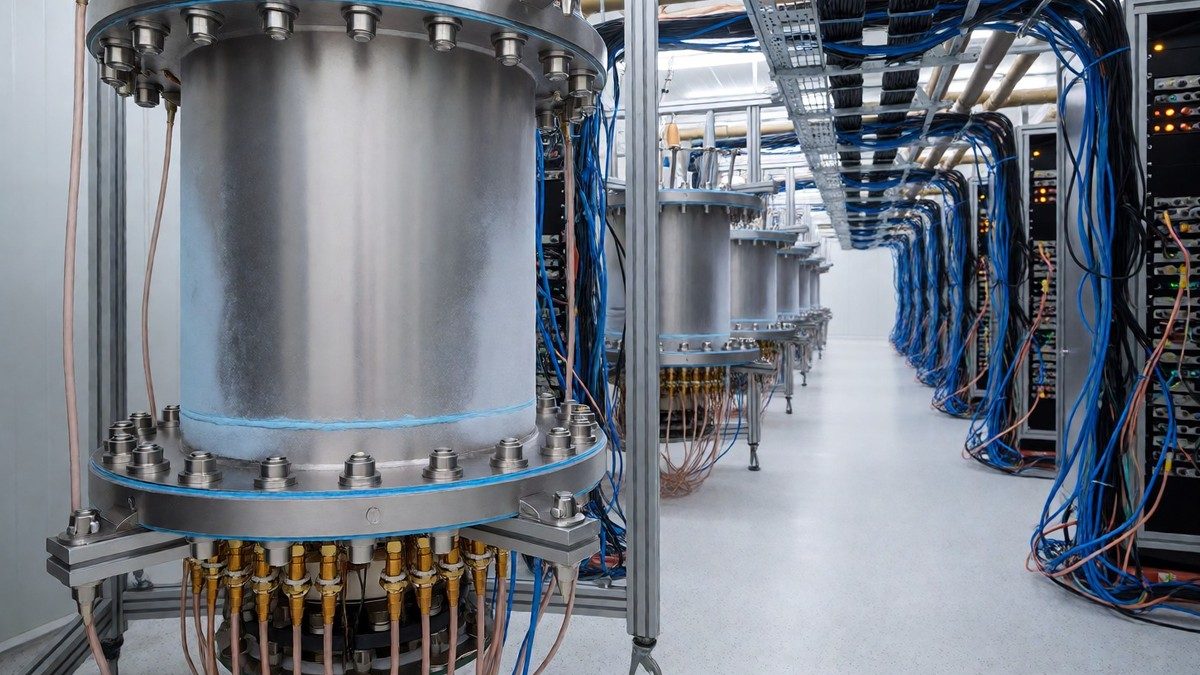
Google’s Willow chip performs a computation in under five minutes that takes the world’s fastest supercomputer 10 septillion years to complete. This 105-qubit processor uses superconducting transmon qubits to operate at temperatures 460 degrees below zero. The hardware achieved a "below threshold" result, meaning error rates decrease as the number of qubits increases. Researchers tested increasing arrays from 3×3 to 5×5 to 7×7 encoded qubits and halved the error rate at each step. This result solves a challenge in quantum error correction that researchers have faced since Peter Shor introduced the concept in 1995.
| Feature | Specification |
|---|---|
| Physical qubit count | 105 |
| Single-qubit gate fidelity | 99.97% |
| Entangling gate fidelity | 99.88% |
| Benchmark task | Random circuit sampling (RCS) |
| Error reduction method | Magic-state cultivation |
Willow uses a technique called magic-state cultivation to produce quantum states with 99.99% logical fidelity. This method reduces errors about 40-fold compared to producing states without cultivation. The team used 54 physical qubits from the 105-qubit processor for this specific experiment. Researchers check candidate states for errors and discard 92 percent of unsuccessful attempts. The algorithm performs a measurement to ask if a state is the right magic state, rather than asking if it is 0 or 1. This process prevents the measurement from collapsing the quantum state.
Speed and verifiability claims
The Willow chip ran the Quantum Echoes algorithm, technically known as the out-of-order time correlator (OTOC). Sundar Pichai stated this algorithm performed 13,000 times faster than the optimal classical algorithm on the world’s fastest supercomputer. This result provides a "verifiable quantum advantage" because other quantum systems can reproduce or validate it. The experiment demonstrates that the result is reproducible, which solves a major problem in the field.
Some researchers remain skeptical about these claims. A researcher on Hacker News noted that the paper in Nature does not explicitly claim to achieve advantage, but instead indicates a "viable path towards" it. They also argued that the paper does not demonstrate portability between two different quantum computers. Other users noted that the 13,000x speedup might result from the team not implementing a "minimal structure" in their classical counterparts.
The Random Circuit Sampling (RCS) benchmark remains a point of contention. Hartmut Neven calls RCS an "entry point" for quantum computing because any team must pass it to prove they can beat classical computers. However, other industry players favor metrics like quantum volume to assess reliability and qubit interactions. Critics of previous Google chips like Sycamore argued that RCS lacks practical applications. Does the ability to solve RCS justify the massive energy and cooling requirements of the hardware?
Practical applications and industrial reach
The ability to reduce errors exponentially brings the industry closer to running practical algorithms. Researchers aim to use this technology for drug discovery by simulating molecular interactions. Pfizer researchers used quantum-inspired techniques to compress processes that previously required massive computational resources. This allows for the screening of hundreds of thousands of molecular candidates.
Willow also has potential uses in materials science and climate modeling. Scientists can simulate how molecules bind or how materials fail at an atomic level. This could lead to better solar cells, more efficient energy grid systems, and the discovery of catalysts to break down plastic pollution. The chip could also support autonomous systems by processing sensor data in real-time.
The hardware moves toward specific scientific goals in the following areas:
- Drug discovery and molecular interaction modeling
- Materials science and corrosion simulation
- Climate modeling and atmospheric interaction prediction
- Battery design and nuclear fusion research
- Artificial intelligence training and optimization
The development of quantum-safe encryption remains a necessary response to these advancements. Organizations already move toward post-quantum encryption standards to protect against quantum-powered hackers. If researchers reach the error rates required for RSA-2048 encryption, they will need one error in 10 billion tries. Current experiments show one error in 10,000 attempts.