The speed of the WSE-3
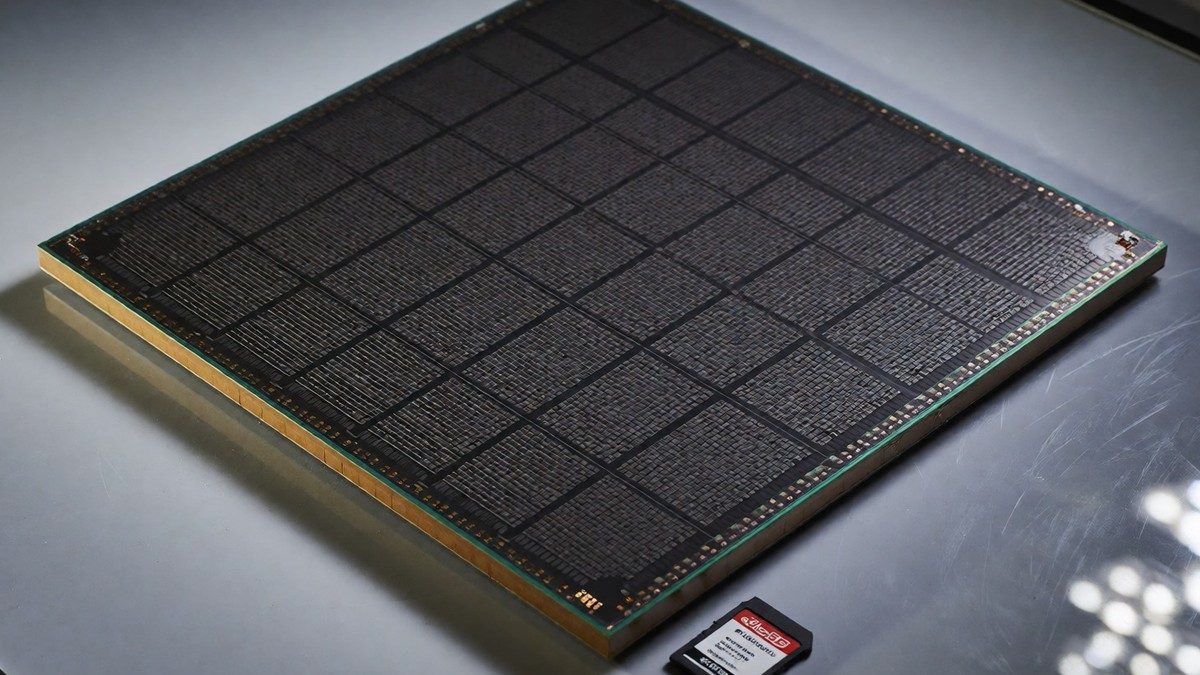
The WSE-3 chip measures 46,225 mm2. This area exceeds the Nvidia H100 die size of 826 mm2 by 57 times. I find the 44 GB of on-chip SRAM more important than the 4 trillion transistors or the 900,000 AI-optimized cores. This memory allows the chip to store model parameters directly, which eliminates the off-chip round trips that slow down traditional GPUs. On Llama 4 Maverick, the WSE-3 delivers 2,500 tokens per second per user, while the Nvidia DGX B200 produces roughly 1,000. This speed gap widens for smaller models like Llama 3.3 70B, where throughput exceeds 1,800 tokens per second. The WSE-3 delivers 125 petaflops of peak AI performance per chip. Each CS-3 system uses a 15U rack that draws roughly 23 kW. The newer WSE-3 Turbo offers 250 PFLOPS of sparse FP16 performance per wafer and 43.2 PB/s of memory bandwidth.
Scaling through Condor Galaxy
The Condor Galaxy network provides scale for training and inference. Condor Galaxy 3 adds 8 exaFLOPs of AI capacity using 64 CS-3 systems. This deployment brings the total network capacity to 16 exaFLOPs. You know that moving weights creates the primary bottleneck for trillion-parameter models. Cerebras solves this by keeping weights stationary on the wafer and routing activations between wafers over RDMA at Ethernet speeds. For the 3-trillion-parameter Kimi K3 model, 59 wafers handle the 1.5 TB of parameters. One wafer handles one dense layer, while two wafers handle a linear-attention layer. The WSE-3 delivers 21 PB/s of memory bandwidth. This partnership with G42 has already trained models like Jais-30B and Med42. OpenAI utilizes this architecture through a $20 billion contract for 750 MW of inference compute capacity. This deal includes a $1 billion loan for data center construction. The agreement provides OpenAI with warrants for up to 33.4 million shares of non-voting stock. Cerebras and G42 plan to reach 36 exaFLOPs of total compute power. Condor Galaxy 1, located in Santa Clara, contains 54 million cores and 4 exaFLOPs of capacity.
Economics and durability
The business faces questions about how long these wafers actually last. Culper Research claims the processors deteriorate and fail after only 18 to 30 months in service. This allegation suggests that continuous operations at peak performance accelerate hardware aging. I think these durability doubts threaten the entire economic model of the company. Law firms including Levi & Korsinsky and Bronstein, Gewirtz & Grossman are looking into possible securities-law violations following the Culper report. UBS lowered its price target for Cerebras from $330 to $250 despite keeping a buy rating. The company reported 2025 revenue of $510 million, which grew 20 times from 2022. However, operating losses hit $145.9 million in 2025. The company holds a $24.6 billion backlog. Cerebras uses a proprietary design with a small fault-tolerant core and a complex routing architecture to achieve 93% silicon utilization, which provides 100 times the fault tolerance of a standard GPU. The company priced its IPO at $185 per share in May 2026, raising $5.55 billion. The roadshow for this offering was 20x oversubscribed. CFIUS cleared a national security review of the G42 relationship in October 2025 after G42 restructured its stake to non-voting shares. Will the company manage to keep its core gross margin above 60% for 2027 if the hardware fails after two years?
| Spec | WSE-3 | WSE-3 Turbo |
|---|---|---|
| Transistors | 4 trillion | 4 trillion |
| AI Cores | 900,000 | 900,000 |
| SRAM | 44 GB | 44 GB |
| Memory Bandwidth | 21 PB/s | 43.2 PB/s |
| Peak AI Performance | 125 PFLOPS | 250 PFLOPS (sparse FP16) |