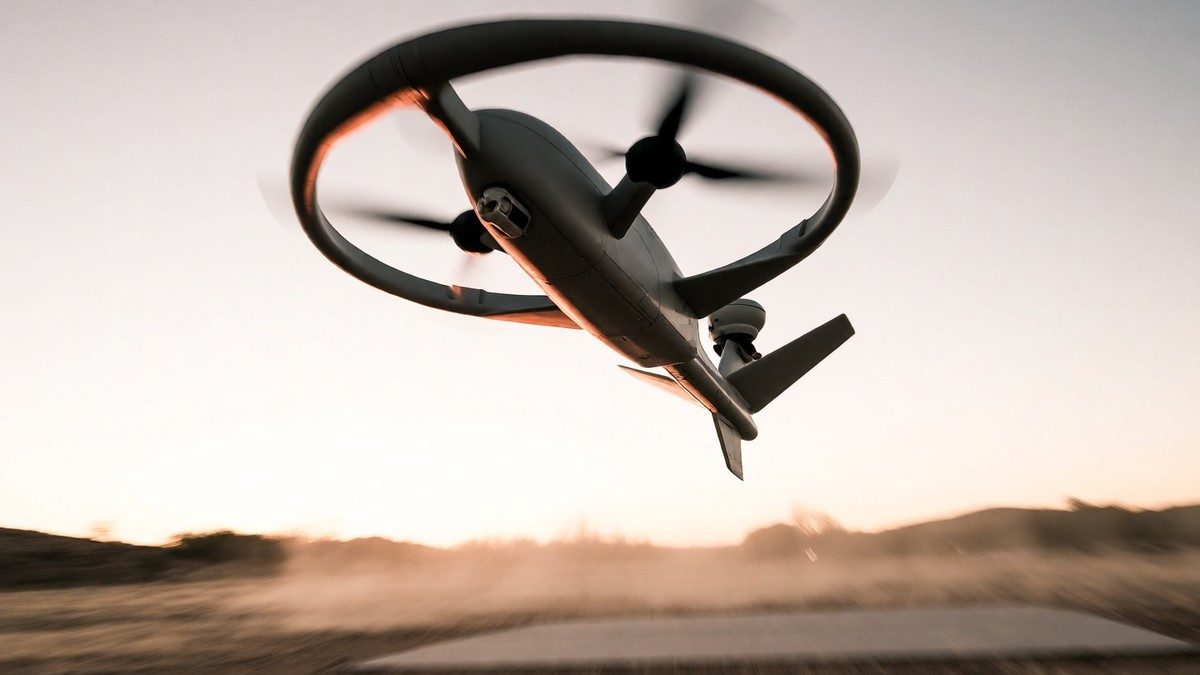
Shield AI’s latest V-BAT Block Upgrade delivers Group 4 and 5 capabilities in a Group 3 package, powered by the Hivemind autonomy stack. The aircraft now carries a heavy-fuel engine optimized for JP-5, extending endurance beyond 13 hours while ensuring compatibility with naval operations. This update enables fully unassisted vertical launch and landing, removing the need for human operators during takeoff or recovery. The system supports multi-payload integration, including ViDAR-enabled passive wide-area motion imagery and synthetic aperture radar. These upgrades allow a single operator to command intelligent teams of aircraft covering up to 30,000 square miles through V-BAT Teams.
Key engineers driving the platform
Andrew Reiter leads State Estimation for the V-BAT, focusing on GPS-denied navigation systems that let the drone localize itself in contested environments. He previously led development of one of Draper Laboratory’s most successful visual-inertial guidance systems before returning to Shield in early 2026 after stints at Fleet Nuclear and Boston Dynamics. Nathan Michael serves as Chief Technology Officer, directing the development and deployment of Hivemind, the modular software that enables rapid fielding of autonomy at scale. His background includes years leading advanced research programs at Carnegie Mellon University, where he directed the Resilient Intelligent Systems Lab. Christian Gutierrez holds the title of Senior Vice President of Hivemind, leading its expansion onto various platforms after twenty years in the U.S. Air Force and ten years at Lockheed Martin. Armor Harris, Senior Vice President of Aircraft Engineering, oversees the development of cutting-edge aircraft and sensors, having previously served as the responsible engineer for SpaceX’s Merlin engines.
Strategic positioning in the CCA race
The V-BAT’s swarming capability positions it within the Pentagon’s Replicator program, which aims to rapidly deploy large numbers of autonomous systems. Shield AI competes directly with Anduril, whose YFQ-44A Fury drone recently launched an AIM-120 missile at a digital target during a live-fire test. While Anduril focuses on jet-powered collaborative combat aircraft, Shield AI differentiates through VTOL flexibility and lower acquisition costs, with each V-BAT unit falling in the mid-six figure range. Ryan Tseng, co-founder and president, emphasizes that V-BAT is built for the full spectrum of drone missions, from deep-penetration ISR-T to border security. Brandon Tseng, also a co-founder, notes that the most forward-thinking militaries are swapping out larger, more expensive ISR aircraft for smaller, affordable drones like V-BAT. The company has secured significant contracts, including a $198 million deal with the U.S. Coast Guard and orders from Poland and the Netherlands. However, critics question whether Boeing can produce the MQ-28 Ghost Bat at a similar cost to what Anduril suggests for Fury, highlighting the intense price competition in this sector. Will Shield AI’s emphasis on attritable, low-cost swarms outweigh the prestige of high-end fighter-class CCAs?