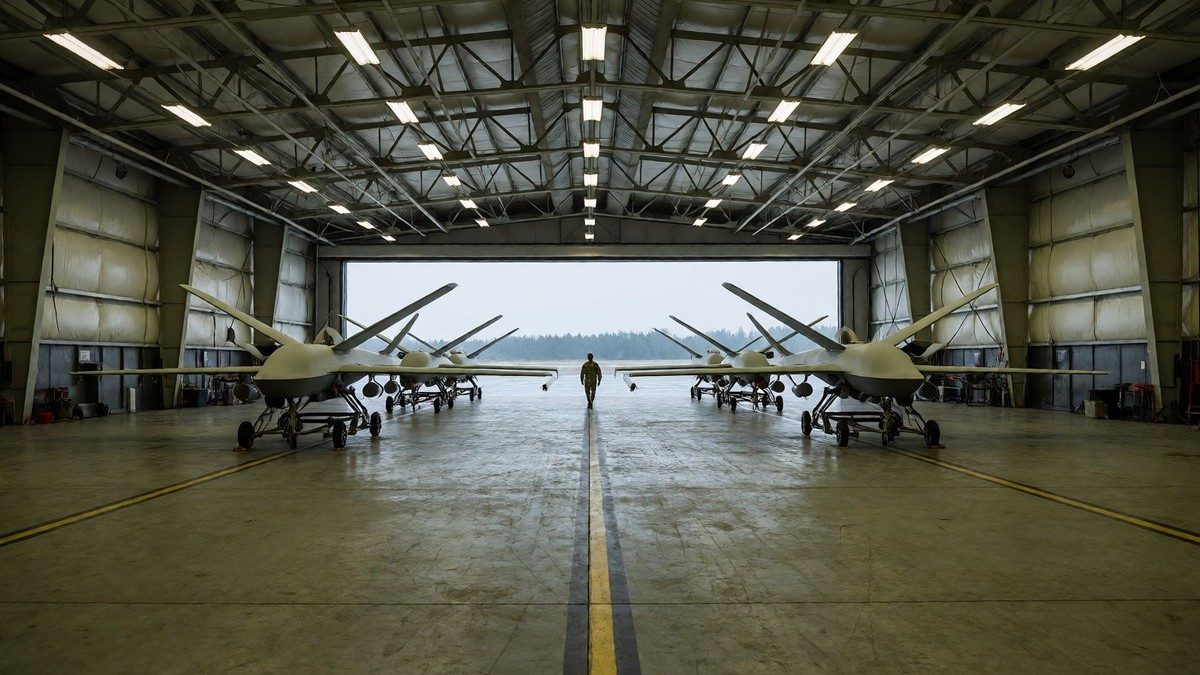
The shift toward autonomous systems
Secretary of Defense Pete Hegseth commands a shift toward drone dominance by 2027. The Pentagon plans to establish a four-star Autonomous Warfare Command, nicknamed AutoWarCom, to field drones and robotic systems by October 1, 2027. This command will possess its own manpower, budget, and acquisition authorities to deploy autonomous systems across all services. Hegseth cites the drone war in Ukraine as evidence that cheap, precise weapons threaten costly legacy platforms. To prepare for this command, Project Agincourt, led by Owen West and Max Strasiser, manages interim efforts. The Army’s FY2026 budget requests $1.7 billion for UAS, C-UAS, and electronic warfare. This funding supports the deployment of non-kinetic effectors like directed energy weapons and high-power microwaves. Soldiers from the 7th Infantry Division recently tested Launched Effects systems, such as Anduril’s Altius 600 and AEVEX Aerospace’s Atlas, in the Pacific Northwest. These systems allow units to conduct reconnaissance missions with greater safety and efficiency. The Army also selected RTX’s Coyote Block 3 for initial testing. Within 90 days, military secretaries must designate at least three national ranges with diverse terrains to facilitate UAS training. By the end of 2026, every squad expects to be equipped with low-cost, expendable drones, focusing first on Indo-Pacific units. The Pentagon also mandates the establishment of dedicated program offices to innovate rapid acquisition methods and engage with industry to identify best practices.
Scale AI and the CDAO data framework
Scale AI provides the data-labeling and decision-support layer for the Department of Defense. The Chief Digital and Artificial Intelligence Office (CDAO) expanded its agreement with Scale AI to a $500 million ceiling in May 2026. This expansion follows a $100 million agreement from September 2025. The contract provides every component across the entire Department of War a streamlined, turn-key pathway to access Scale AI’s end-to-end capabilities, including data labeling, model development, and generative AI platforms across NIPR, SIPR, and JWICS networks. Scale AI delivers training data, evaluations, and RL environments through its Data Engine and Outlier platform. This contract gives Scale AI a two to three year runway. Its Enterprise Atlas service provides RL environments on MCP servers, CLI, and GUIs. Scale AI provides annotations for text, video, geospatial, and image data through its Data Engine. The company uses machine learning strategies to accelerate annotation and uses subject matter experts to ensure model precision and accuracy. Scale AI’s training data and evaluations assist in building reliable AI systems for the world’s most important decisions.
| Capability | Scale AI Specification |
|---|---|
| CDAO Contract Ceiling | $500 million |
| RL Environment Product | Enterprise Atlas |
| Open Source Platform | AgentEnv |
| Data Workforce | Outlier platform |
Safety conflicts and market shifts
The Pentagon’s drive for maximum lethality creates friction with AI safety policies. In February 2026, the Department of War designated Anthropic a supply chain risk because the company refused to remove safety guardrails against autonomous weapons and mass surveillance. This designation blacklisted Anthropic from the defense contractor ecosystem. Anthropic filed federal lawsuits in the Northern District of California and a D.C. federal appeals court, arguing that the designation violates the First and Fifth Amendments. OpenAI secured a $200 million defense pact shortly after this dispute. You should recognize that the ability to scale autonomous systems depends entirely on the quality of the data used to train them. The February 28 missile strike in Minab, Iran, killed 157 people, including 123 children, due to a mix of AI dependence and hasty target selection. The designation of Anthropic as a supply chain risk remains a blatant use of federal procurement law to punish a company for its safety policies. If machine judgment leads to such errors, how will the military maintain distinction between combatants and civilians?