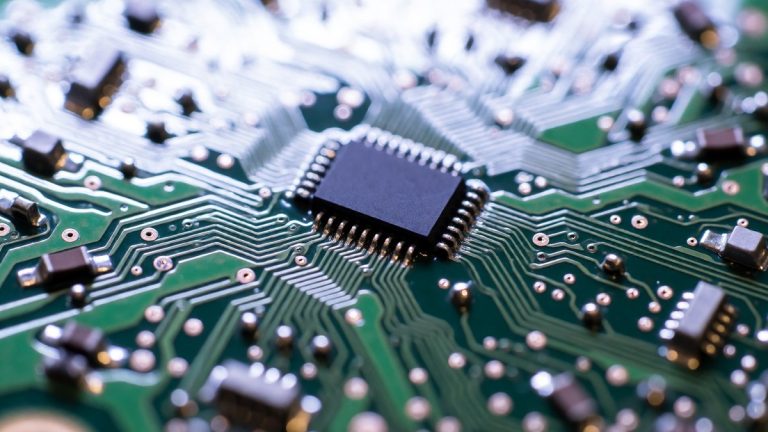

The NVIDIA Blackwell B200 carries 208 billion transistors on a dual-die design using TSMC’s 4NP process. This architecture replaces the single-die Hopper H100. The B200 provides 192 GB of HBM3e memory and 8 TB/s of bandwidth. These specifications create a performance gap between the H100 and the B200 that affects both training and inference.
Hardware specifications for next-generation AI workloads
The transition from Hopper to Blackwell involves changes in memory, compute, and interconnect speeds. The H100 carries 80 GB of HBM3 with 3.35 TB/s of bandwidth. The H200 improves this with 141 GB of HBM3e and 4.8 TB/s of bandwidth. The B200 pushes these limits higher with 192 GB of HBM3e and 8 TB/s of bandwidth.
| Specification | NVIDIA H100 | NVIDIA H200 | NVIDIA B200 |
|---|---|---|---|
| Architecture | Hopper | Hopper | Blackwell |
| Memory Capacity | 80 GB HBM3 | 141 GB HBM3e | 192 GB HBM3e |
| Memory Bandwidth | 3.35 TB/s | 4.8 TB/s | 8 TB/s |
| TDP | 700W | 700W | 1000W |
| Interconnect | NVLink 4 | NVLink 4 | NVLink 5 (1.8 TB/s) |
The B200 provides 192 GB of HBM3e memory at 8 TB/s bandwidth, which allows the GPU to read model weights faster during the decode phase, preventing the compute cores from sitting idle while waiting for data to arrive from the memory. This bandwidth advantage scales with the fifth-generation NVLink, which delivers 1.8 TB/s of bidirectional bandwidth per GPU.
Scaling training throughput with larger batch sizes
The B200 delivers 33% faster training speeds than the H100 for computer vision workloads. One test used YOLOv8-x with DINOv2 distillation on the ImageNet-1k dataset containing 1.28 million images. The B200 carries enough memory to increase the batch size from 2048 to 4096. This increase in batch size results in a 57% speedup compared to the H100 at the same batch size.
NVIDIA Blackwell systems also lead in large-scale training benchmarks. A DGX GB200 NVL72 cluster trained GPT-3 175B in 3.1 minutes. An 8-GPU MI350X node trained the same model in 4.8 minutes, which is roughly 55% slower. The B200 provides 2.2x the training performance of H100 systems according to MLPerf Training v4.1 results.
The B200 provides higher throughput by utilizing the second-generation Transformer Engine. This engine supports FP4 and FP6 precision, which allows the hardware to handle more operations per cycle. In MLPerf Training v4.1, the Blackwell architecture showed its capacity to handle dense and sparse workloads with high efficiency.
Memory bandwidth and the inference bottleneck
LLM inference is a memory-bandwidth problem rather than a compute problem. During the decode phase, the GPU reads the entire model weight matrix from memory for every token generated. The B200 provides 8 TB/s of bandwidth, while the H100 provides 3.35 TB/s. This difference determines how many tokens a GPU can produce per second.
The B200 delivers 4x the inference throughput of the H100. This gain comes from the 2.4x increase in memory bandwidth and the support for FP4 precision. Using FP4 reduces the memory footprint by 2x compared to FP8. This allows the B200 to serve larger models or more tokens with the same hardware.
At a cost level, the B200 provides a 7x reduction in inference cost compared to the H100. This happens because the throughput gains outpace the higher hourly rental price. The B200 delivers tokens at $0.02 per million, while the H100 delivers them at $0.14 per million.
You know the difference between a compute-bound and a memory-bandwidth-bound task, so look at how these numbers scale.
The battle against AMD MI355X
AMD competes with NVIDIA using the CDNA 4 architecture and the MI355X chip. The MI355X carries 288 GB of HBM3E memory, which exceeds the 192 GB found on the B200. This capacity allows the MI355X to hold larger models on a single GPU.
The MI355X hits 97% of the B200 batch throughput on the Llama 2 70B benchmark. It beat the B200 by 11-15% on the GPT-OSS 120B model. An 8-GPU MI355X cluster delivers 30% higher inference throughput than 8-GPU B200 clusters on the 405B model. These results demonstrate the memory advantage of the CDNA 4 architecture. The gap in throughput narrows as model sizes increase.
AMD positions the MI355X as a competitive option for large-scale inference. The MI355X delivers 2.6 times the inference throughput of an H100 on models like Llama 3.1 405B. For users running models that require massive memory, the MI355X provides a path to lower costs per token.
Software maturity and the inference performance gap
The software ecosystem determines the actual utility of the hardware. NVIDIA uses the CUDA platform, which has decades of development. The Transformer Engine in Blackwell automates switching between FP4 and FP8 precision. This automation helps maintain accuracy while increasing throughput.
The B200 performance shows limitations when running specific large models through Ollama. For the Gemma 27B model, the B200 provides a 10% speedup in token generation. For the DeepSeek 671B model, B200 performance remained on par or slightly slower than the H100. This occurred because optimized frameworks like vLLM were not available or stable on Blackwell hardware during the testing period.
The software stack includes TensorRT-LLM, which optimizes inference via kernel improvements and programmatic dependent launch. Recent updates to TensorRT-LLM increased the throughput of Blackwell GPUs by up to 2.8x in three months. The maturity of the software stack remains a variable in how well the B200 reaches its theoretical performance.
Will the B200 software stack bridge the parity gap with AMD’s MI355X by the end of the year?
Managing VRAM for large language model fine-tuning
Fine-tuning requires significant memory for model weights, optimizer states, gradients, and activations. For a 70B parameter model like Llama 3, full fine-tuning in FP16 requires 140 GB for weights, 840 GB for optimizer states, and 140 GB for gradients. This totals over 1.1 TB of VRAM.
The B200 carries 192 GB of HBM3e, which reduces the need for multi-GPU sharding. Using QLoRA, engineers can reduce the memory footprint. QLoRA freezes the base weights in 4-bit precision and trains low-rank adapter matrices. This method allows a Llama 3 70B model to be fine-tuned using only 41 GB of VRAM on an 80 GB GPU.
The B200 provides a 2.2x performance advantage over the H100 for Llama 2 70B LoRA fine-tuning. The 192 GB capacity allows for larger batch sizes during the fine-tuning process. Larger batch sizes stabilize gradient updates and improve convergence quality.
Power requirements and cooling needs
The B200 requires more power than previous generations. The HGX B200 operates at 1000W, while the H100 operates at 700W. This 43% increase in TDP affects data center infrastructure. A single 8x B200 node draws 4.8 kW for the GPUs alone. Including CPUs, RAM, and storage, the total system draw reaches 6.5 to 7 kW at the wall.
Higher power density makes cooling a priority. Air cooling works for the B200, but NVIDIA expects higher adoption of liquid cooling. Liquid cooling keeps GPUs up to 35°C cooler, which improves reliability.
The power draw also impacts the cost of running a cluster. Running an 8-GPU B300 server at full load for a year at $0.10/kWh costs roughly $13,000 in power. This cost does not include the cooling overhead or the cost of the hardware itself.
The math of self-hosting vs cloud rental
Self-hosting an 8x B200 cluster costs $0.51 per GPU per hour in operating expenses. This figure includes colocation, power, and cooling. Cloud H100 instances cost between $2.95 and $16.10 per hour. Self-hosting provides a 6x to 30x cost advantage on an operational basis.
Building a self-hosted cluster requires upfront capital expenditure. An 8x B200 system requires approximately $400,000 for the GPUs. Monthly operating costs for colocation and power reach approximately $3,000. Using H100 instances on providers like Nebius costs $17,000 per month, while AWS or GCP on-demand rates can exceed $70,000 per month.
A team spending $10,000 monthly on GPUs can reach a break-even point with self-hosting. Cloud providers offer sustained usage discounts of 30% to 60%, which extends the break-even period for owned hardware. Self-hosting provides guaranteed performance and 24/7 availability without the overhead of virtualization or noisy neighbors. The B200 pays for itself quickly for high-throughput inference workloads.